Expanding Your Horizons is a once a year conference for middle school girls, held at colleges across the country. It happened today at Contra Costa College, and I taught a workshop on using Scratch.
I've been a computer programmer in the past, so it wasn't hard to pick up enough to get started. Scratch is a free programming environment in which you use scripts to control characters called sprites. You can add sound effects and movement, and make cartoons, stories, or games.
I think the girls had fun. I promised to post on my blog so they could ask me questions here. Any questions?
Friday, March 26, 2010


Wednesday, March 24, 2010
Friday, March 19, 2010
Math Teachers at Play #24
Check it out!
I'm looking forward to thinking about these puzzles Denise posted:
I can't tell you my favorites, because I haven't had time to look through more than a few entries yet. (And if I don't post this link now, I might just forget.)
I think I'll savor it all on Sunday morning. Enjoy!
I'm looking forward to thinking about these puzzles Denise posted:
- 24 can be written as the sum of three square numbers. How?
- Can 24 be written as the sum of two consecutive integers? Can 24 be written as the sum of three or more consecutive integers? How many ways?
[Which reminds me: Did you figure out the consecutive-integer puzzle from MTaP #22?]
- How many ways can the letters M-A-T-H be arranged to form a 4-letter “word”? Okay, since there’s no 24 in the question, you’ve probably already guessed the answer — but can you prove it?
- 24 is the largest number divisible by all numbers less than its square root. Can you find all of the other numbers for which this is true?
- 24 is an abundant number, which means that if you add up all the numbers that divide evenly into 24 (except for 24 itself), the sum will be greater than 24 itself. How many other abundant numbers can you find which are less than 100?
- What is the ones digit in the number 24^24?
[That means 24 raised to the 24th power.]
I can't tell you my favorites, because I haven't had time to look through more than a few entries yet. (And if I don't post this link now, I might just forget.)
I think I'll savor it all on Sunday morning. Enjoy!
Thursday, March 18, 2010
What Are the Myths About Math?
Have I mentioned lately that I'm working on a book? The title has changed; now it's Playing With Math: Stories from Math Circles, Homeschoolers, and the Internet. I'm working with over 15 authors on chapters, and a bunch of my favorite bloggers are contributing posts. (If you'd like to contribute a blog post, email me at mathanthologyeditor on gmail - maybe I can fit it in. I don't have a publisher for sure yet. If the one I'm talking with doesn't work out, I'll probably go with lulu.com.)
I posted before on math myths, but that was a long time ago, and I've been giving it some more thought because I'd like to start the book out with this. I've rearranged and changed things up a bit. But I wonder if I've left anything important out. Can you help me?
(Some of the wording in my list below comes from Mind Over Math, by Kogelman and Warren, a great book for overcoming math anxiety. But I’ve added and changed things quite a bit.)
Who does math?
Myth #1: Some people have a 'math mind' and some don't.
Math #2: Math requires logic, not intuition. Math is not creative.
Myth #3: Men are better at math than women.
What do young people need?
Myth #4: Elementary school math is all about arithmetic.
Myth #5: It's bad to count on your fingers.
Myth #6: Gotta memorize those time tables.*
How is math done?
Myth #7: Learning math is about learning how to follow a procedure, and there's lots to memorize.
Myth #8: It's always important to get the answer exactly right, and you must always know how you got the answer.
Myth #9: Mathematicians do problems quickly, in their heads, and math is done by working intensely until the problem is solved.
Myth #10: There is a best way to do math problems.
So. What's missing from this list?
___
* I'd better put my reply to myth #6, or I'll catch way too much flak. It's a myth only because parents worry more about that than about whether their kids are learning problem-solving skills - hoe to really use math. Here's my draft response to this myth:
Sure, they'll need to know their times tables, for all sorts of reasons. But if someone doesn't memorize easily, give them something more intriguing to think about, where they get slowed down, but not stopped, by not knowing their times tables. The skill will develop in this need-to-know context.
Drill is likely to put a fact in the part of your brain that holds meaningless information like phone numbers. But our brains are much more adept at handling the things that have lots of connections. If you can get the times tables memorized in a way where they’re being used, that’s the best.
I posted before on math myths, but that was a long time ago, and I've been giving it some more thought because I'd like to start the book out with this. I've rearranged and changed things up a bit. But I wonder if I've left anything important out. Can you help me?
(Some of the wording in my list below comes from Mind Over Math, by Kogelman and Warren, a great book for overcoming math anxiety. But I’ve added and changed things quite a bit.)
Who does math?
Myth #1: Some people have a 'math mind' and some don't.
Math #2: Math requires logic, not intuition. Math is not creative.
Myth #3: Men are better at math than women.
What do young people need?
Myth #4: Elementary school math is all about arithmetic.
Myth #5: It's bad to count on your fingers.
Myth #6: Gotta memorize those time tables.*
How is math done?
Myth #7: Learning math is about learning how to follow a procedure, and there's lots to memorize.
Myth #8: It's always important to get the answer exactly right, and you must always know how you got the answer.
Myth #9: Mathematicians do problems quickly, in their heads, and math is done by working intensely until the problem is solved.
Myth #10: There is a best way to do math problems.
So. What's missing from this list?
___
* I'd better put my reply to myth #6, or I'll catch way too much flak. It's a myth only because parents worry more about that than about whether their kids are learning problem-solving skills - hoe to really use math. Here's my draft response to this myth:
Sure, they'll need to know their times tables, for all sorts of reasons. But if someone doesn't memorize easily, give them something more intriguing to think about, where they get slowed down, but not stopped, by not knowing their times tables. The skill will develop in this need-to-know context.
Drill is likely to put a fact in the part of your brain that holds meaningless information like phone numbers. But our brains are much more adept at handling the things that have lots of connections. If you can get the times tables memorized in a way where they’re being used, that’s the best.
Sunday, March 14, 2010
Pi Day: What's Your Favorite Discovery?
Here's mine...
Maria D posted a link to this beauty on her Natural Math google group. This is my first time embedding a youtube video on my blog. I'm embarrassed to admit that something that turned out to be so easy was intimidating to me. (In case you're like me: Youtube has a box labeled embed on the right hand side of the page. Copy, choose "edit HTML" at your blog, paste.)
Here's another embarrassing admission: For many years, I thought of and
and  as just "formulas". I only recently (last 10 years, that's recent for me) realized that the second of those is almost the definition of
  .
.
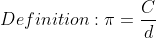
If we could measure perfectly, we'd measure around the edge of any circle (C is for circumference) and across the middle (d is for diameter), and then divide. It's always the same, and that's what is. "Ohh, now I get it!"
[Edited on 3-15 to add:] Jumping from basic to advanced, here's a 6-part series working through a proof that is irrational (by Brent at The Math Less Traveled). I did fine for the first 3 or 4 parts, and then lost steam when there was a delay between posts. I've wanted to understand this for years, so I'll go back soon and work my way all the way through it. Unfortunately, this proof is not at all intuitive - understanding the proof is not the same as really having a feel for why must be irrational.
My son just woke up. I found my compass, and showed it to him. ("I've seen that before," he says, trying to seem bored.) Then I tried to draw 6 circles around a center one, but I guess I squeezed the compass as I went, because the outer circles didn't meet up like they should have. Time for Geometer's Sketchpad (or geogebra, for those of you who've learned it) ...

[Formulas and symbol created at codecogs.]
Maria D posted a link to this beauty on her Natural Math google group. This is my first time embedding a youtube video on my blog. I'm embarrassed to admit that something that turned out to be so easy was intimidating to me. (In case you're like me: Youtube has a box labeled embed on the right hand side of the page. Copy, choose "edit HTML" at your blog, paste.)
Here's another embarrassing admission: For many years, I thought of
If we could measure perfectly, we'd measure around the edge of any circle (C is for circumference) and across the middle (d is for diameter), and then divide. It's always the same, and that's what
[Edited on 3-15 to add:] Jumping from basic to advanced, here's a 6-part series working through a proof that
My son just woke up. I found my compass, and showed it to him. ("I've seen that before," he says, trying to seem bored.) Then I tried to draw 6 circles around a center one, but I guess I squeezed the compass as I went, because the outer circles didn't meet up like they should have. Time for Geometer's Sketchpad (or geogebra, for those of you who've learned it) ...

What's your favorite Pi Day discovery?
[Formulas and
Wednesday, March 10, 2010
Good and Bad Logarithm Problems, at JD's
JD asks, Why don’t I like these logarithm questions? And the discussion is great.
Tuesday, March 9, 2010
You Can Count on Monsters, by Richard Evan Schwartz

Schwartz is a mathematician and an artist, and his monsters are the numbers from 1 to 100. Number one is sad because it can't play the factoring game with the other numbers. He shows why, with factors trees that have 1's included, and can just go on forever. (His factor trees have the branches going up; mine have always gone down.)

The prime numbers are the basic monsters, and the other monsters are made from strange conglomorations of their prime factors. Searching for the factors in the composite monsters is sometimes easy (that's the 10 monster to the right) ...

Sometimes hard (that's 99 to the left)...
And always interesting.

My 7-year-old son was confused by 8. He thinks of 8 as four 2's, but there are only three 2's in the picture. I think it's a good confusion. My guess is that he'll eventually get how the composite monsters are made from other numbers, and then the 8 monster will suddenly feel right.
At the end, Schwartz gives lovely explanations of how to find the primes, and why they go on forever.
Available for $24.95 at AK Peters (the publisher); cheaper at Amazon (but check that shipping charge to make sure).
_____
[Transparency: I got my copy of this book for free, as a review copy. But I think I might just buy 2 or 3 copies to give as presents. Yum!]
Saturday, March 6, 2010
It's a link kind of day.
John Spencer has a good way to think about one of the troubles with textbooks and other imposed curricula.
Rebecca Zook tells how talking about fractions "the Chinese way" helped one student learn and like fractions better.
For John Conway fans, his recipe for success. Thanks, Tanya!
Science Teacher quotes Diane Ravitch, who spoke on Democracy Now (transcript down the page). Here's another Ravitch quote:
Rebecca Zook tells how talking about fractions "the Chinese way" helped one student learn and like fractions better.
For John Conway fans, his recipe for success. Thanks, Tanya!
Science Teacher quotes Diane Ravitch, who spoke on Democracy Now (transcript down the page). Here's another Ravitch quote:
The Obama administration appointed somebody from the NewSchools Venture Fund to run this so-called “Race to the Top.” The NewSchools Venture Fund exists to promote charter schools. So, what we’re seeing with the proliferation—with this demand from the federal government, if you want to be part of this $4 billion fund, you better be prepared to create lots more charter schools.And the discussion over at Kate's f(t), about how to convince folks of the right answer to the 3 door problem, is great.
Thursday, March 4, 2010
Probability: Behind one of these doors is a new car...
Perhaps you've all heard of the "Monty Hall" Problem? I hope this is new to a few of you. I'm writing about it today because I just learned about a twist in the controversy over it I hadn't heard before.
Monty Hall was the host of Let's Make a Deal, and would often play a game with contestants where he would show them 3 doors.

Behind one was a brand new car, and behind the other two were stinky old goats. You pick a door, and he shows you a goat behind one of the other doors. He now allows you to switch. Do you do it? (We'll assume you prefer new cars to old goats.)
Marilyn Vos Savant wrote about it in Parade Magazine in September, 1990. She got piles of letters in response, mostly from people who disagreed with her analysis. (I'm trying to avoid giving away the answer here, so you can play with the problem yourself.) She was right, but a number of mathematicians told her she was wrong. How is that possible for such a simple little problem?! I think it's because we trust our intuition too much.
I remember reading that column when it came out, and getting the answer 'wrong'. But that's because I made an assumption that she didn't address one way or the other in her statement of the problem. I assumed the game show host would try to mislead you. To do this as a math problem, it's important to add one thing to the statement I gave above. You need to know that the host will always show another door with a goat behind it, and offer you a chance to switch.
And that is what I just read an article about. Monty Hall himself pointed it out in an interview with John Tierney in the New York Times. (It was published way back in 1991, but a discussion of probability problems this morning led me there.) That article will tell you how to solve the problem, so don't click until you're ready to see their answer.
Have fun!
Monty Hall was the host of Let's Make a Deal, and would often play a game with contestants where he would show them 3 doors.

Behind one was a brand new car, and behind the other two were stinky old goats. You pick a door, and he shows you a goat behind one of the other doors. He now allows you to switch. Do you do it? (We'll assume you prefer new cars to old goats.)
Marilyn Vos Savant wrote about it in Parade Magazine in September, 1990. She got piles of letters in response, mostly from people who disagreed with her analysis. (I'm trying to avoid giving away the answer here, so you can play with the problem yourself.) She was right, but a number of mathematicians told her she was wrong. How is that possible for such a simple little problem?! I think it's because we trust our intuition too much.
I remember reading that column when it came out, and getting the answer 'wrong'. But that's because I made an assumption that she didn't address one way or the other in her statement of the problem. I assumed the game show host would try to mislead you. To do this as a math problem, it's important to add one thing to the statement I gave above. You need to know that the host will always show another door with a goat behind it, and offer you a chance to switch.
And that is what I just read an article about. Monty Hall himself pointed it out in an interview with John Tierney in the New York Times. (It was published way back in 1991, but a discussion of probability problems this morning led me there.) That article will tell you how to solve the problem, so don't click until you're ready to see their answer.
Have fun!
Saturday, February 27, 2010
Sue's Top Ten Issues in Math Education
In my last post, I mentioned my top ten list of 'problems'. I decided to call it my top ten 'issues' because I wanted to frame them in the positive - not what's wrong, but how to do it right. However, this is still a list of the top ten problems, because most of this is done wrong in most classrooms.
And here they are:
1. If you're going to teach math, you need to enjoy it.*
The best way to help kids learn to read is to read to them, lots of wonderful stories, so you can hook them on it. The best way to help kids learn math is to make it a game (see #3), or to make dozens of games out of it. Accessible mysteries. Number stories. Hook them on thinking. Get them so intrigued, they'll be willing to really sweat.
2. If you’re going to teach math, you need to know it deeply, and you need to keep learning.
Read Liping Ma. Arithmetic is deeper than you knew (see #6). Every mathematical subject you might teach is connected to many, many others. Heck, I'm still learning about multiplication myself. Over at Axioms to Teach By, I said (back in September), "You don't want the product to be 'the same kind of thing'. ... 5 students per row times 8 rows is 40 students. So I have students/row * rows = students." Owen disagreed with me, and Burt's comment on my last post got me re-reading that discussion. I think Owen and I may both be right, but I have no idea how to use a compass and straightedge to multiply. I'm looking forward to playing with that. I think it will give me new insight.
3. Games are to math as books are to reading. Let the kids play games (or make up their own games) instead of "doing math", and they might learn more math.
Denise's game that's worth 1000 worksheets (addition war and its variations) is one place to start. And Pam Sorooshian has this to say about dice. Learn to play games: Set, Blink, Quarto, Blokus, Chess, Nim, Connect Four.
4. Students are willing to do the deep work necessary to learn math if and only if they’re enjoying it.
Which means that grades and coercion are really destructive. Maybe more so than in any other subject. People need to feel safe to take the risks that really learning math requires. Read Joe at For the Love of Learning. (Maybe you'll get to read him here soon.) I'm not sure if this is true in other cultures. Students in Japan seem to be very stressed from many accounts I read; they also do some great problem-solving lessons.
5. Math is not facts (times tables) and procedures (long division), although those are a part of it; more deeply, math is about concepts, connections, patterns. It can be a game, a language, an art form. Everything is connected, often in surprising and beautiful ways.
My favorite math ed quote of all time comes from Marilyn Burns: "The secret key to mathematics is pattern."
U.S. classrooms are way too focused on procedure in math. It's hard for any one teacher to break away from that, because the students come to expect it, and are likely to rebel if asked to really think. (See The Teaching Gap, by James Stigler.)
See George Hart for the artform. I don't know who to recommend for the language angle. Any recommendations?
6. Math is not arithmetic, although arithmetic is a part of it. (And even arithmetic has its deep side.)
Little kids can learn about infinity, geometry, probability, patterns, symmetry, tiling, map colorings, tangrams, ... And they can do arithmetic in another base to play games with the meaning of place value. (I wrote about base eight here, and base three here.)
7. Math itself is the authority - not the curriculum, not the teacher, not the standards committee.
Read Math Mojo – you can’t want kids to do it the way you do. You have to be fearless, and you need to see the connections.
8. Real mathematicians ask why.
If you’re trying to memorize it, you’re probably being pushed to learn something that hasn’t built up meaning for you. See Julie Brenna's article on Memorizing Math Facts. Yes, eventually you want to have the times tables memorized, just like you want to know words by sight. But the path there can be full of delicious entertainment. Learn your multiplications as a meditation, as part of the games you play, ...
Just like little kids, who ask why a thousand times a day, mathematicians ask why. Why are there only 5 Platonic (regular) solids? Why does a quadratic (y=x2), which gives a U-shaped parabola as its graph, have the same sort of U-shaped graph after you add a straight line equation (y=2x+1) to it? (A question asked and answered by James Tanton in this video.) Why does the anti-derivative give you area? Why does dividing by a fraction make something bigger? Why is the parallel postulate so much more complicated than the 4 postulates before it?
9. Earlier is not better.
The schools are pushing academics earlier and earlier. That's not a good idea. If young people learn to read when they're ready for it, they enjoy reading. They read more and more; they get better and better at it; reading serves them well. (See Peter Gray's recent post on this.) The same can happen with math. Daniel Greenberg, working at a Sudbury school (democratic schools, where kids do not have enforced lessons) taught a group of 9 to 12 year olds all of arithmetic in 20 hours. They were ready and eager, and that's all it took.
In 1929, L.P. Benezet, superintendent of schools in Manchester, New Hampshire, believed that waiting until later would help children learn math more effectively. The experiment he conducted, waiting until 5th or 6th grade to offer formal arithmetic lessons, was very successful. (His report was published in the Journal of the NEA. Although some people disagree about the success of this experiment, there is nothing published which contradicts his evidence. I'd like to find more information about how this project ended.)
10. Textbooks are trouble. Corollary: The one doing the work is the one doing the learning. (Is it the text and the teacher, or is it the student?)
Hmm, this shouldn't be last, but when I look at the list, they all seem important. I guess this isn't a well-ordered domain. ;^) Textbook Free: Kicking the Habit is an article by Chris Shore on getting away from using a textbook. (After clicking the link, click on 'Articles'.) I've been duly inspired, and will report in the fall about how it goes for me in my classes to teach without a textbook. See dy/dan on being less helpful (so the students will learn more).
31. Multiplication is not (just) repeated addition, it’s much richer than that.
Wait. I said that already... (I warned you, it's just not in my top ten.)
What do you see as the biggest issues or problems in math education?
____
*I know, top ten lists are supposed to start at number ten to keep the suspense up. But the suspense is gone - I already told you my top two in my last post. And I can't help it, I just have to start at the top.
And here they are:
1. If you're going to teach math, you need to enjoy it.*
The best way to help kids learn to read is to read to them, lots of wonderful stories, so you can hook them on it. The best way to help kids learn math is to make it a game (see #3), or to make dozens of games out of it. Accessible mysteries. Number stories. Hook them on thinking. Get them so intrigued, they'll be willing to really sweat.
2. If you’re going to teach math, you need to know it deeply, and you need to keep learning.
Read Liping Ma. Arithmetic is deeper than you knew (see #6). Every mathematical subject you might teach is connected to many, many others. Heck, I'm still learning about multiplication myself. Over at Axioms to Teach By, I said (back in September), "You don't want the product to be 'the same kind of thing'. ... 5 students per row times 8 rows is 40 students. So I have students/row * rows = students." Owen disagreed with me, and Burt's comment on my last post got me re-reading that discussion. I think Owen and I may both be right, but I have no idea how to use a compass and straightedge to multiply. I'm looking forward to playing with that. I think it will give me new insight.
3. Games are to math as books are to reading. Let the kids play games (or make up their own games) instead of "doing math", and they might learn more math.
Denise's game that's worth 1000 worksheets (addition war and its variations) is one place to start. And Pam Sorooshian has this to say about dice. Learn to play games: Set, Blink, Quarto, Blokus, Chess, Nim, Connect Four.
4. Students are willing to do the deep work necessary to learn math if and only if they’re enjoying it.
Which means that grades and coercion are really destructive. Maybe more so than in any other subject. People need to feel safe to take the risks that really learning math requires. Read Joe at For the Love of Learning. (Maybe you'll get to read him here soon.) I'm not sure if this is true in other cultures. Students in Japan seem to be very stressed from many accounts I read; they also do some great problem-solving lessons.
5. Math is not facts (times tables) and procedures (long division), although those are a part of it; more deeply, math is about concepts, connections, patterns. It can be a game, a language, an art form. Everything is connected, often in surprising and beautiful ways.
My favorite math ed quote of all time comes from Marilyn Burns: "The secret key to mathematics is pattern."
U.S. classrooms are way too focused on procedure in math. It's hard for any one teacher to break away from that, because the students come to expect it, and are likely to rebel if asked to really think. (See The Teaching Gap, by James Stigler.)
See George Hart for the artform. I don't know who to recommend for the language angle. Any recommendations?
6. Math is not arithmetic, although arithmetic is a part of it. (And even arithmetic has its deep side.)
Little kids can learn about infinity, geometry, probability, patterns, symmetry, tiling, map colorings, tangrams, ... And they can do arithmetic in another base to play games with the meaning of place value. (I wrote about base eight here, and base three here.)
7. Math itself is the authority - not the curriculum, not the teacher, not the standards committee.
Read Math Mojo – you can’t want kids to do it the way you do. You have to be fearless, and you need to see the connections.
8. Real mathematicians ask why.
If you’re trying to memorize it, you’re probably being pushed to learn something that hasn’t built up meaning for you. See Julie Brenna's article on Memorizing Math Facts. Yes, eventually you want to have the times tables memorized, just like you want to know words by sight. But the path there can be full of delicious entertainment. Learn your multiplications as a meditation, as part of the games you play, ...
Just like little kids, who ask why a thousand times a day, mathematicians ask why. Why are there only 5 Platonic (regular) solids? Why does a quadratic (y=x2), which gives a U-shaped parabola as its graph, have the same sort of U-shaped graph after you add a straight line equation (y=2x+1) to it? (A question asked and answered by James Tanton in this video.) Why does the anti-derivative give you area? Why does dividing by a fraction make something bigger? Why is the parallel postulate so much more complicated than the 4 postulates before it?
9. Earlier is not better.
The schools are pushing academics earlier and earlier. That's not a good idea. If young people learn to read when they're ready for it, they enjoy reading. They read more and more; they get better and better at it; reading serves them well. (See Peter Gray's recent post on this.) The same can happen with math. Daniel Greenberg, working at a Sudbury school (democratic schools, where kids do not have enforced lessons) taught a group of 9 to 12 year olds all of arithmetic in 20 hours. They were ready and eager, and that's all it took.
In 1929, L.P. Benezet, superintendent of schools in Manchester, New Hampshire, believed that waiting until later would help children learn math more effectively. The experiment he conducted, waiting until 5th or 6th grade to offer formal arithmetic lessons, was very successful. (His report was published in the Journal of the NEA. Although some people disagree about the success of this experiment, there is nothing published which contradicts his evidence. I'd like to find more information about how this project ended.)
10. Textbooks are trouble. Corollary: The one doing the work is the one doing the learning. (Is it the text and the teacher, or is it the student?)
Hmm, this shouldn't be last, but when I look at the list, they all seem important. I guess this isn't a well-ordered domain. ;^) Textbook Free: Kicking the Habit is an article by Chris Shore on getting away from using a textbook. (After clicking the link, click on 'Articles'.) I've been duly inspired, and will report in the fall about how it goes for me in my classes to teach without a textbook. See dy/dan on being less helpful (so the students will learn more).
31. Multiplication is not (just) repeated addition, it’s much richer than that.
Wait. I said that already... (I warned you, it's just not in my top ten.)
What do you see as the biggest issues or problems in math education?
____
*I know, top ten lists are supposed to start at number ten to keep the suspense up. But the suspense is gone - I already told you my top two in my last post. And I can't help it, I just have to start at the top.
Subscribe to:
Posts (Atom)

 Posts
Posts